
How To Build a Funnel That Converts 🔄
Est. read time: 2 mins
The key to consistent & successful digital marketing, is systems.
Marketing Without Architecture
Many SMEs’ marketing looks like this:
Ads → Homepage → Hope
OR
Social Post → DM → Manual reply → Silence
There is no defined path and optimisation logic.
Marketing becomes reactive instead of systematic.
How A Simple, High-Performing Funnel Looks Like 🎯
A real funnel doesn’t need to be complex. It just needs to be intentional.
1️⃣ Clear Attention
Be specific about:
Who it’s for
The problem
The outcome

2️⃣ Single-Purpose Conversion Page
Use a focused landing page with:
One core message
One clear Call-To-Action (e.g. “Buy Now”, “Subscribe For More”)
Proof & credibility (e.g. reviews, testimonials, a video of the product or service in action)
This can be a different page from your website homepage, if it makes the journey clearer.
3️⃣ Lead Capture Layer
Install a data capture layer.
This can be in the form of a:
Quote form
Booking link
Low-ticket entry offer
If you don’t capture data, you pay repeatedly to reach out to the same people.
4️⃣ Structured Follow-Up
Most buyers don’t convert on the first touch.
Implement a follow-up layer which can take the form of a:
3 - 5 email nurture sequence
Retargeting ads
Objection handling
Follow-up turns interest into revenue.
5️⃣ Measurement & Optimisation
Track:
Cost per lead
Cost per booking
Cost per acquisition
Return on ad spend
Then improve the weakest link.
Don’t guess - know where to optimise.
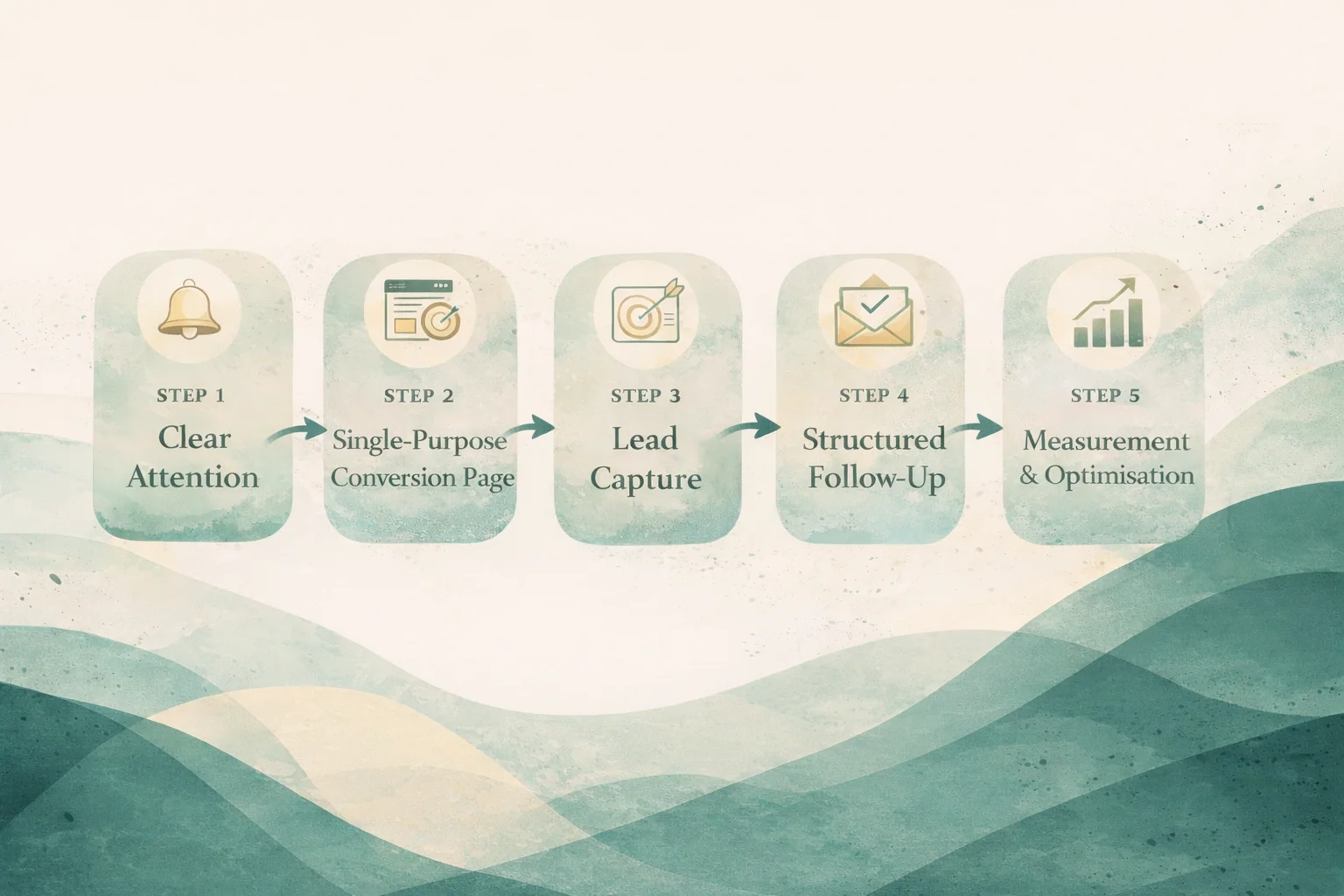
Summary chart of a simple, high-performing funnel
The Powerful Multiplier Most SMEs Ignore ❯❯❯❯
Instead of blindly increasing traffic (which you have to pay a lot more for), improve your conversion rate.
If 1,000 visitors convert at 2% → 20 leads.
Improve to 3% → 30 leads.
That’s 50% more leads without spending more.
Conversion rate optimisation is often the highest-ROI lever.
And a large part of it is implementing a funnel architecture like what was said before.
